Darkness

I was halfway through writing a post about why the capitalist consumerism of Christmas bums me out when I stopped mid-sentence and burst out laughing. Oh my god I thought, I am so morbid.

I immediately thought about a conversation I recently had with my sister. 

I am a writer. I have been a writer since I started crafting my own letters and narrating my own stories to picture books in kindergarten. That being said, I’ve never shared my writing with anyone. I have a bachelor’s in history. I’ve written history. I’m getting a masters in curriculum and instruction; I’ve written curriculum. But my personal writing, the contents of my brain, and my heart, and my soul; I’ve never shared that.

And now I am. With this blog. This is my first taste of uncensored sharing of the deepest part of my brain, and my heart, and my soul. And it scares me. And I know people are reading it. Not that many people, but still, people. But I am getting zero feedback. Not negative, not positive, just none.

Well, that’s not completely fair, nor true I guess. There have been a few who have reached out and thanked me, told me they’re proud of me, and told me to keep it up. I appreciate that feedback so much! Knowing I have support at all has been key to keeping me going.

But I’ve not gotten any specific feedback. No critiques, no comments about how certain things made people feel, or how they may have been changed because of what they read, or how they connected to something I said. And that makes me hella anxious.

I don’t know how people are actually reacting to my writing.

When I voiced my concerns to my sister, her answer was so simple I had to mull it over for a few days before I was able to accept it as true. Basically, she said there is nothing wrong with my writing. It is honest, it is unflinching, it is dark. And people have a difficult time processing through the kind of feelings this writing makes them feel. 

I knew she was right. It made sense. My darkness has been present my entire life. I remember my mom freaked out when I was in preschool because I said my favorite color was black and she thought I was depressed (I don’t really remember if I was yet, but hey).

The reality is, I’ve always been drawn to thinking really deeply, realistically, and morbidly about things. I’ve always been drawn to dark colors, late-night discussions, cemeteries, and the quiet solitude of large bodies of water at night. My curiosity is ignited by decaying buildings, bones, skulls, fungus. I relish the intellectual challenge of true crime, against the background of the crimes themselves. 

It probably isn’t a coincidence that I’m also terrified of most of the things I just named.

I have no idea where that morbidity comes from. Maybe it is just my depression manifesting in my personality. Maybe I am just a pessimist. Either way, I’ve slowly come to realize how my darkness can make others uncomfortable. My sister is right, darkness scares people. Darkness brings up feelings people usually try to avoid. Sure, I have set my own darkness free and am glorying in the freedom I feel because of it. But a lot of people are perfectly happy suppressing their darkness and keeping it positive.

I guess it makes sense the masses wouldn’t want to consistently have to confront something they fear so much. 

I realize that, just because I’m ready to talk about this stuff, that doesn’t mean everyone is. 

I guess I hope that one day, we will progress as a people to regard the darkness with less fear. For, why should darkness be so scary? Why are we so terrified of the unknown? Why do we literarily apply the color black to evil things, “the dark side?” 

In the meantime, dear readers, I realize the emotional rollercoaster I’ve taken you on. I thank those of you who have returned to more than one of my posts. I will work on sharing more of my triumphant feelings associated with my mental health journey to lighten the tone a little (at least more so than I am now). And I promise I won’t ruin your holiday with a rant about my critical analysis of the Christmas season. 

All I ask in return is that you allow yourself to spend more time with your darkness. Ride the wave of that uncomfortable feeling, let it all out, and see where it takes you. Allow yourself some time to really process through an intense emotion, and see what you find out about yourself in the process. 

Love & Happiness to you all. 

Taking Up Space

I have diminished myself to the point of feeling invisible because of a very strong voice in my head. This is the voice of The Patriarchy, and I have spent a lifetime letting it erase me. Another way to think about The Patriarchy, or rather a manifestation of it, is heteronormativity. In short, heteronormativity is the idea that a two-person, financially stable, monogamous, child-rearing relationship is the right kind of relationship. It is what everyone should strive for.

I want to be clear that there are many more layers of The Patriarchy than just heteronormativity. However, when I say “The Patriarchy” here, I am referring to heteronormativity because the word heteronormativity is so unknown I still get the red squiggle underline when I type it out. Therefore, I failed in finding a word to refer to “heteronormativity” that is as easy to read and recognize as “The Patriarchy.” I realize it is an imperfect use of the term as it doesn’t refer to every layer of The Patriarchy. The Patriarchy in itself is many-headed and complex, unable to be sufficiently conquered in one blog post. I encourage you to continue to seek out and read about diverse perspectives on The Patriarchy, dominant culture, and colonialism. If you’re interested start here, here, and here. I am one limited perspective, but I am not the only valid perspective.

My family, my community, my culture growing up was so entrenched in The Patriarchy, I have spent my 28 years of life trying to suppress, hide, and destroy all the parts of myself The Patriarchy wouldn’t approve of. But I’ve found, no matter how much education and experience I have, no matter how many awards and honors I receive, I still felt vile, dirty. I felt unworthy of love because it all came only if I suppressed everything within me that made me, me. Let me illustrate my point with some examples:

My Voice

I am a lifelong learner. I challenge everything. I question everything. I always want to discuss everyone’s perspective, I want to learn as much as I can behind someone’s motives. This quality has placed me at the receiving end of a great deal of displeasure throughout my life.

With The Patriarchy inevitably comes gender roles. I received indirect, but specific, messaging around gender roles growing up. Men are supposed to be strong, angry, protective. They make the money, make the decisions, run the country. Women, on the other hand, are meek, fragile, and agreeable. They rear the children, maintain the home, sooth the man’s ego when he returns at the end of a hard day of running the world. I’m not alone in receiving this messaging. I grew up in the 90s. The television and movies I watched as a child presented this model relationship to me over and over again.

My personality has never gelled well with these gender roles. I am independent. I am challenging. As a result, my formative years contained a lot of training to shut down that part of me. I was often told to “stop talking.” I was called difficult, antagonistic. I was told to mind my business, shut my mouth. Stop being so loud, so argumentative. I was called a know-it-all and a bitch. Over time, in order to avoid this push-back, I just stopped using my voice. I stopped raising my hand in class, stopped asking questions, stopped trying to enter discussions. By the time I hit high school, I spent most of my day in silence. My voice disappeared and, my self esteem was so low, I wished my body could disappear too. I didn’t make many friends unless they were willing to engage with me and push passed my training. I didn’t get my voice back until well into college, but always knew where to toe the line and back down when the aggressive reactions to my voice started again.

My Body

The gender roles enforced by The Patriarchy taught me to hand over the keys to my body to the men that have come in and out of my life. I learned from an early age that my goal was to find a man willing to take care of me, start a family, and settle down. Men on the other hand, they need to spread their seed. Sow their oats. They would only commit when they found “THE woman,” who would be interesting enough to do so with (watch Friends all the way through and you’ll see exactly what I mean).

Indirectly, this messaging, coupled with my already low self esteem, caused my brain to equate male attention with self worth. From puberty onward I manufactured my outward appearance and disposition to be attractive to men. I made their interests my interests. I complimented them and said what I knew they wanted to hear. I never said no. I let myself be used. I engaged in flirting and texting and casual sex because I thought it gave me purpose, was a marker of my success as a woman. And then, eventually, when I tried to say no to a boy with whom I had been flirting, who was practically a stranger, I was raped. Violently.

Ironically, my rape resulted in increased promiscuity. It taught me that everyone and everything was right all along. In my head, me saying “no” was the result of my attack so I pushed my voice and my sense of self even further down. I erased myself and allowed my body to be used by whomever wanted to, however they wanted. My body became public property. It became an empty shell.

My Sexuality

I am bisexual (Surprise! And sorry to all my family members and friends who follow my blog, whom I was incapable of telling in a more personal and appropriate way). The thing is, bisexuality doesn’t fit into The Patriarchy. The Patriarchy is dedicated to the gender binary. Men are men, women are women, men and women are attracted to each other and stable monogamy is their goal. Growing up, I heard over and over again that bisexuality isn’t real. That the people engaging in it are just confused, looking for attention, or going through a phase. This is a phenomenon called bi erasure, and it is real.

Bi erasure worked its way so deeply into my subconscious I even remember saying things like “No one is bi. Boys who say they are bi are really just gay. It is more natural for women to experiment with other women, but that doesn’t mean they’re not straight.” Looking back, not only does this make me cringe, it makes sense. I was trying desperately not to make myself even more of an “other” than I already felt I was because of my voice. I was desperate to justify my crushes on Jessica Rabbit, Britney Spears, and three of the girls I went to high school with. I wanted to erase my sexuality so I could only engage in the kind of heterosexual relationship The Patriarchy would approve of.

The suppression of my sexuality resulted in a lot of self loathing. I was embarrassed, I felt gross, I felt like I didn’t fit in. I married a man, a man whom I love very much, before I ever allowed myself to admit that I’m bisexual. And this blog post is the first time I’m telling many people in my life because I am still scared of the potential push back I may get from all the same voices in society who started striking when I was young.

My Mind

All of this training from The Patriarchy resulted in various rules and limits I put on myself in order to reach success in the eyes of The Patriarchy. I got tattoos as a way to get the control over my body back, but only in places that could easily be covered by clothes so I would still appear worthy of respect. In undergrad, I learned how to produce writing based on what my professors wanted, rather than what I thought. I got a career in teaching, to appear noble, respectable, and stable. I pushed myself to excellence, held ridiculously high expectations for myself, strove for perfection. All so not a single teacher, boss, or coworker would have anything to complain about in my job performance. I married a man, bought a house, my credit score is over 800.

In short, I did everything The Patriarchy wanted me to do. All the while, denying everything that would make me feel fulfilled, genuine, alive, interested, connected, happy. I erased all of my passions so I could focus on teaching. I never had a hobby. I became a workaholic. I never said no to a single thing my job demanded of me. I punished myself every time I slipped up, or let my attention waver. The only thoughts I reserved for myself were criticisms. Functionally, I was successful from the point of view of The Patriarchy. I was also fucking miserable.

So, after 28 years of suppressing everything that made me feel alive, I wanted to die.

But I don’t want to die. I want to live. As myself. I want to be free. I want to explore and experiment. I want to connect intellectually, creatively, and spiritually with people who also don’t fit into The Patriarchy, or at least don’t need me to. I want ownership over what makes me feel successful. I want ownership over what gives me worth. I don’t want to be invisible anymore.

I want to be seen.

I want to take up space.

A Night in the Brain of a Depressed Person Whose Working on It

I have been attending a Partial Hospitalization Program since Monday 12/2/19. This program is 9:00a-3:30p Monday through Friday and includes group therapy and CBT/DBT skills training. Opening myself up to being vulnerable and experiencing rather than suppressing my emotions is new for me. When I came home on Thursday night I unwittingly mounted a roller coaster of my own emotions, the following is a transcript.

Parks in front of house.

Turns off car.

Head down on steering wheel.

Exhausted.

Depressed.

Why am I depressed?
Why do I still hate myself?
I know this is a distortion.
These thoughts are distortions.
How do I reframe these thoughts?
I can’t reframe these thoughts, because I am worthless.
I am broken.
Stopthoughtstopthoughtstopthoughtstopthought

Distracted enough to forget the thought.

Gets out of car.

Walks into house.

Changes clothes. Doesn’t put pants back on.

Sits down on couch.

Bursts into tears.

Why am I crying?
Am I sad?
Do I feel depressed?
This feels like a good cry.
I’m just gonna keep crying and see where this takes me.
Ugly crying. Sobbing.
Sobbingsobbingsobbing.

Dog jumps on chest and licks all over face.

Laughing now.

Happy now.

Euphoric now. Not sure why. Rides wave.

Turns on Spotify.

Puts on favorite song. LOVE FEAT. ZACARI.

Bursts into tears.

I miss my best friend we always used to listen to this song when we hung out I hate that he lives so far away he probably doesn’t miss me at all. No. That’s a distorted thought. You’re trying to read his mind. How can you reframe this thought? He has a life and a girlfriend and a job and he’s living his best life and you’re so happy for him it’s ok that he is absent you actually see him more than you would think considering and everything is ok everything is ok everything is ok everything is ok everything is ok

Cries harder. It’s a good cry not a sad cry now though.

Receives message from someone I haven’t talked to in a while.

It’s a fun conversation.

Thinking about fun interesting things.

Content. Excited. Warm and Fuzzy.

Old friend asks to hang out.

Shuts down immediately.

I can’t hang out. I can’t do it. Last time I saw him I was my best self and we are having an awesome conversation and he thinks I’m this interesting fun person and I’m not and if we hang out he’s just going to realize I’m not this interesting fun person he thinks I am and then I’ll have to deal with rejection which will be inevitable no these are distorted thoughts too how do I reframe these thoughts? I am an interesting fun person just sometimes I get depressed and isolate from people but I’m working on it and every day getting closer to being this interesting fun person more often and I think I could probably hang out with him on a day I feel up to it

Feels better.

Feels calmer. Less anxious. Contentment returning.

Husband comes home. Sees mountain of tissues. Are you Sick?

No I’m crying.

Husband immediately gets concerned.

It’s ok it was a good cry.

Husband makes dinner.

Starts to make and set up Christmas decorations to Christmas music.

Thinks about how lucky it is to have a husband who isn’t scared away by crazy.

Bursts into tears.

Big hugs.

Lots of kisses.

Heart warms.

Exhausted.

Rebirth

Today in therapy I learned the Latin root of my name is Renatus, which means “reborn.”

I’ve been in full-time therapy since Monday and, as the sun finally starts to come out in my brain, I can’t help but feel the significance of this meaning.

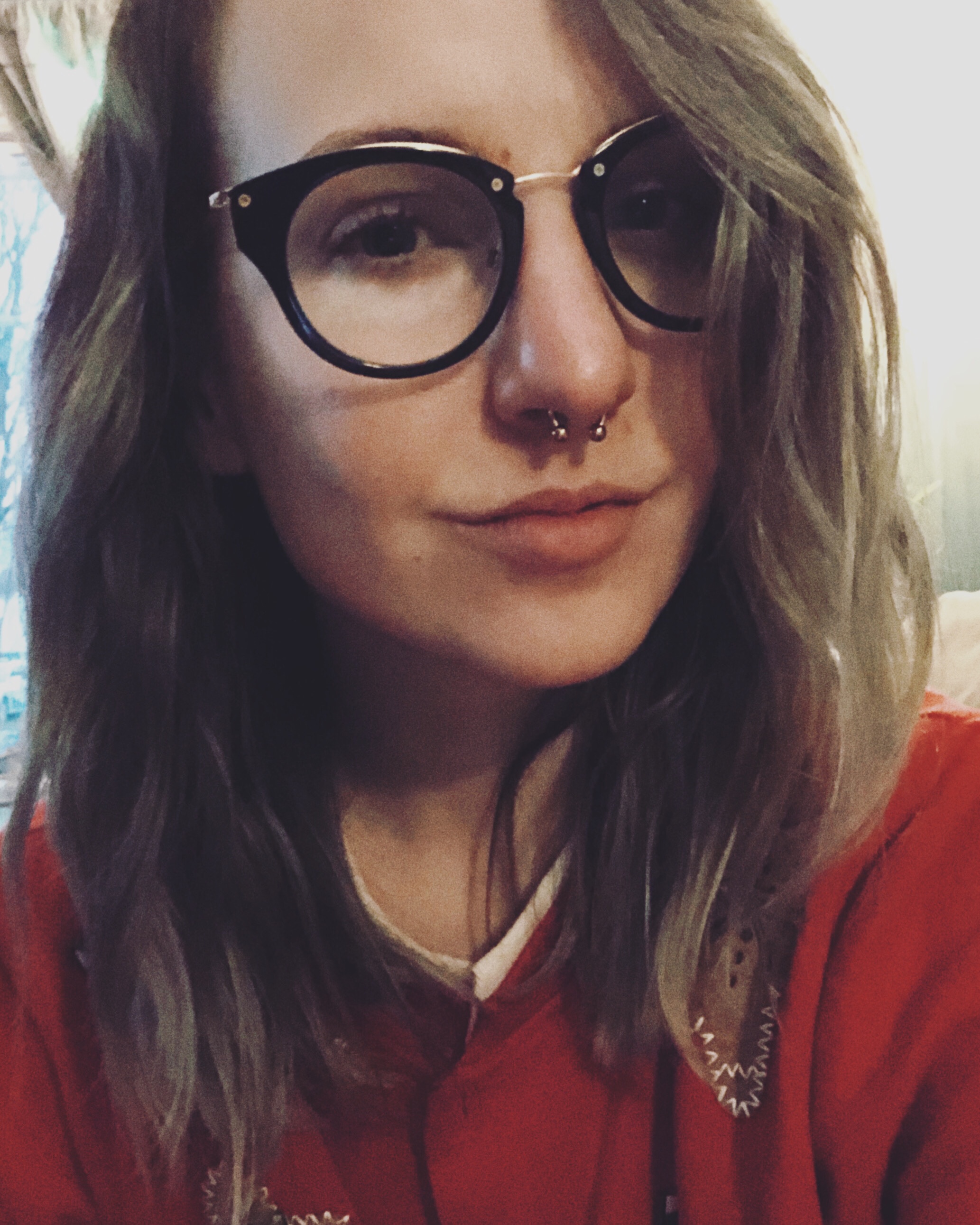
So, to celebrate my emotional gestational period, here’s a selfie of me without makeup, in a Christmas sweater I picked up off my bedroom floor and had to smell before I put it back on.

Cheers to rebirth, finding my way back to self love, and the UofM hospital psychiatric team

Why “the Holidays” are Hard When You Have Depression

Disclaimer: I was raised in a white Christian household in a Judeo-Christian community in America. I don’t assume that I speak for anyone who celebrates any other sort of holiday in any other sort of cultural community.

As I sat on my couch on the Wednesday night before Thanksgiving, trying to write a post about my feelings towards Thanksgiving this year, I was literally paralyzed with anxiety. No words would come out. My interior monologue reached a level of chaos that resulted in my brain short-circuiting. I had to put my computer away, pour myself a glass of wine, do some yoga, watch an episode of Modern Love on Amazon Prime. That’s how anxious Thanksgiving made me.

Disclaimer #2: My anxiety had nothing to do with Thanksgiving itself, although I know that is a reality for many. If you would like to know more about how I’ve tried to decolonize my brain and my thoughts on Thanksgiving, don’t talk to me, read and learn from the actual source. You can access indigenous voices on the topic here and here. Challenging my white family members on our views of Thanksgiving does make me anxious every year, but I see it as my duty and I don’t allow myself the right to complain about it.

Happy Thanksgiving from my family!

Then I realized I was anxious for many reasons that are indicative of our cultural stigmas around mental health, our societal culture of “toxic positivity,” and norms around what is and isn’t acceptable as “small talk” with people you don’t see very often. Luckily, my Thanksgiving was actually pretty amazing. There were fewer people there than usual. The relatives that did come are people I see fairly often (who are already updated on my life). None of my worst-case-scenarios came true and I was able to take breaks when I was feeling overwhelmed.

That being said, I decided I should still write a post about my feelings leading up to “the holiday season” this year, as I have a feeling I’m not alone in this anxiety. So, below you will find some of the things associated with the holidays that make them so damn hard when you have depression.

“How are you?”

I hate this question. As a culture, Midwestern Americans especially ask this question as if it’s another greeting. A mere synonym for saying hello. The problem is, I have met very few distant acquaintances/extended family members who actually are interested in how you are doing. Instead, the expected response is a simple “good” or “fine” or, if you’re feeling spicy, “living the dream.” Then we get to move on with a surface-level conversation, re-breaking the ice that formed between us over the passed months of little to no contact.

The problem is, I’m not good. I don’t feel fine. And I am definitely not living out my dreams right now. I am depressed. I just spent 48 hours in a psychiatric hospital because I made, and almost acted on, a suicide plan. I am taking a two month leave from work. But when people ask how I am, they are generally not looking for me to unload on them about my depression. They don’t want to hear the details of my low self-esteem and PTSD. When people ask “How are you?” they are looking for the culturally accepted stock-answer that will help them break the ice and feel more comfortable.

This cultural norm makes me feel trapped. I no longer have the emotional capacity to pretend everything is fine to make others feel more comfortable. Forcing myself to paste a smile on my face and make small talk like this is forcing myself back into the bottom of the well of my depression. It makes me feel disconnected, alone, invisible. Since my mental breakdown, I have decided I don’t want to pretend anymore. I don’t want to lie and say I’m fine when I’m not. And if my answer makes the questioner uncomfortable, maybe don’t ask how I am if you don’t want to hear a genuine answer.

And, ultimately, why? Why would my genuine answer make someone uncomfortable? Why would a family member, who claims to care about me, who is asking how I am, feel uncomfortable with me talking to them about my depression? Knowing my depression makes others uncomfortable is part of what kept me from opening up about it in the first place. This need to hide my depression and appear is if everything is fine for the sake of others’ comfort is part of what forced me on the island that led to my suicidal ideation in the first place.

Catching Up

Last year, at my family’s Christmas Eve party, I announced that I was the 2019 recipient of a prestigious award in public teacher terms, especially as a 4th year teacher. This year, at my family’s Christmas Eve party, I have nothing to announce. My only “news” going on in my life right now is my mental breakdown.

I only see many of my family members twice a year: for Christmas and for our family reunion in the summer time. We are not unique in this pattern. “The Holidays” are a popular time of year for making announcements as most people can count on getting their family in one place for in-person communication and celebration. Even sans important announcements, these infrequent meetings usually result in a great deal of catching up. I can expect a lot of questions about my life, my job, and the general goings-on over the previous six months of not seeing each other.

Let me be clear, the practice of asking about your family members’ lives is not a bad thing. The problematic part is our cultural stigmas about what types of “news” people often feel comfortable sharing and/or hearing about. Telling my family about an award I won was exciting and exhilarating. I announced it with pride, confidence, and (dare I say) swagger. On the other hand, having a mental breakdown, spending time in a psychiatric hospital, and taking a leave from work; all that doesn’t seem like news I should be sharing. It’s too negative, too dark.

When I think about answering my relatives’ queries with the truth about what is going on with me, I feel embarrassed and ashamed. Like I somehow failed (especially in comparison with where I was in my career last year). Furthermore, the topic of mental health isn’t something many families I know talk about openly. I’ve operated within a dynamic my entire life where we only talk about happy things because we don’t want to bum anyone out or make anyone uncomfortable.

This seems harmless. If I don’t see someone for a while we obviously want to keep our time together positive and fun. Unfortunately, this is an example of “toxic positivity.” According to Psychology Today, “The phrase “toxic positivity” refers to the concept that keeping positive, and keeping positive only, is the right way to live your life. It means only focusing on positive things and rejecting anything that may trigger negative emotions.” Forcing ourselves to only share positive things reinforces feelings of shame and failure when you are going through something that isn’t positive. Feeling ashamed of my depression is part of what made it so difficult for me to seek help. Feeling like my loved ones don’t want to hear about my darkness reinforced my need to pretend everything was fine. This led to those same feelings of isolation and invisibility. My depression is part of me. I don’t want to be ashamed of it anymore.

Hugging

If your family is like mine, everyone expects a hug hello, and a hug goodbye (I also have 27 first cousins, and my family events run 100 people strong so this process takes some time). I love my family very much. I am not a hugger.

Being forced to hug family members as a kid was the earliest messaging I received that my body is not my own property. I have anxiety. Part of my anxiety is an extreme discomfort being touched by people with whom I don’t have an intimate relationship. Regardless of my feelings towards hugging, I grew up in a socio-cultural environment where it was considered rude if I didn’t hug even one family member in both greeting and farewell. If I refused to hug someone, my elders would be disappointed in my “attitude.”

The knowledge that I will be forced to hug 100+ people that I barely ever see is daunting. Attending a family party means knowingly walking into a situation where I will be forced out of my physical comfort zone against my will over and over again. Additionally, the knowledge that my natural boundaries around physical touch is a disappointment to my family members increases my feelings of shame and failure about my mental health.

I do love “the holidays.” Like many people I know, some of my favorite childhood and family memories center around this time of year. But I also have depression and anxiety, and navigating the holidays and mental health is difficult. If you’re reading this and you have a family member that suffers with mental health issues, think about what it would take to be an ally to them as they navigate the social politics of family functions this time of year. Although spending time with family can be stressful, it was also my family that made my Thanksgiving so pleasant as the people in attendance chose understanding and support over commitment to social norms. And that’s all I can really ask for.