I have been attending a Partial Hospitalization Program since Monday 12/2/19. This program is 9:00a-3:30p Monday through Friday and includes group therapy and CBT/DBT skills training. Opening myself up to being vulnerable and experiencing rather than suppressing my emotions is new for me. When I came home on Thursday night I unwittingly mounted a roller coaster of my own emotions, the following is a transcript.
I miss my best friend we always used to listen to this song when we hung out I hate that he lives so far away he probably doesn’t miss me at all. No. That’s a distorted thought. You’re trying to read his mind. How can you reframe this thought? He has a life and a girlfriend and a job and he’s living his best life and you’re so happy for him it’s ok that he is absent you actually see him more than you would think considering and everything is ok everything is ok everything is ok everything is ok everything is ok
Cries harder. It’s a good cry not a sad cry now though.
Receives message from someone I haven’t talked to in a while.
It’s a fun conversation.
Thinking about fun interesting things.
Content. Excited. Warm and Fuzzy.
Old friend asks to hang out.
Shuts down immediately.
I can’t hang out. I can’t do it. Last time I saw him I was my best self and we are having an awesome conversation and he thinks I’m this interesting fun person and I’m not and if we hang out he’s just going to realize I’m not this interesting fun person he thinks I am and then I’ll have to deal with rejection which will be inevitable no these are distorted thoughts too how do I reframe these thoughts? I am an interesting fun person just sometimes I get depressed and isolate from people but I’m working on it and every day getting closer to being this interesting fun person more often and I think I could probably hang out with him on a day I feel up to it
Feels better.
Feels calmer. Less anxious. Contentment returning.
Husband comes home. Sees mountain of tissues. Are you Sick?
No I’m crying.
Husband immediately gets concerned.
It’s ok it was a good cry.
Husband makes dinner.
Starts to make and set up Christmas decorations to Christmas music.
Thinks about how lucky it is to have a husband who isn’t scared away by crazy.
Today in therapy I learned the Latin root of my name is Renatus, which means “reborn.”
I’ve been in full-time therapy since Monday and, as the sun finally starts to come out in my brain, I can’t help but feel the significance of this meaning.
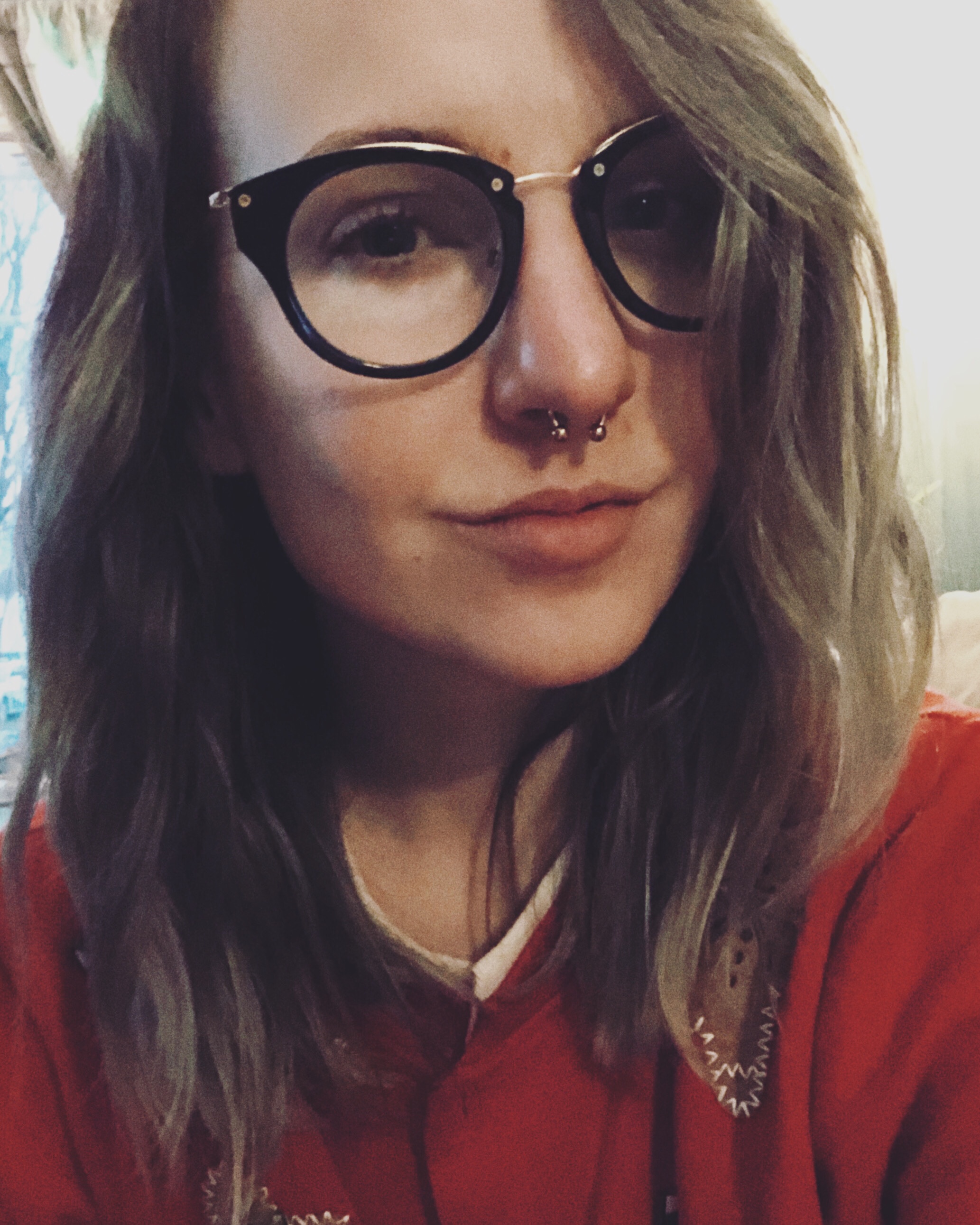
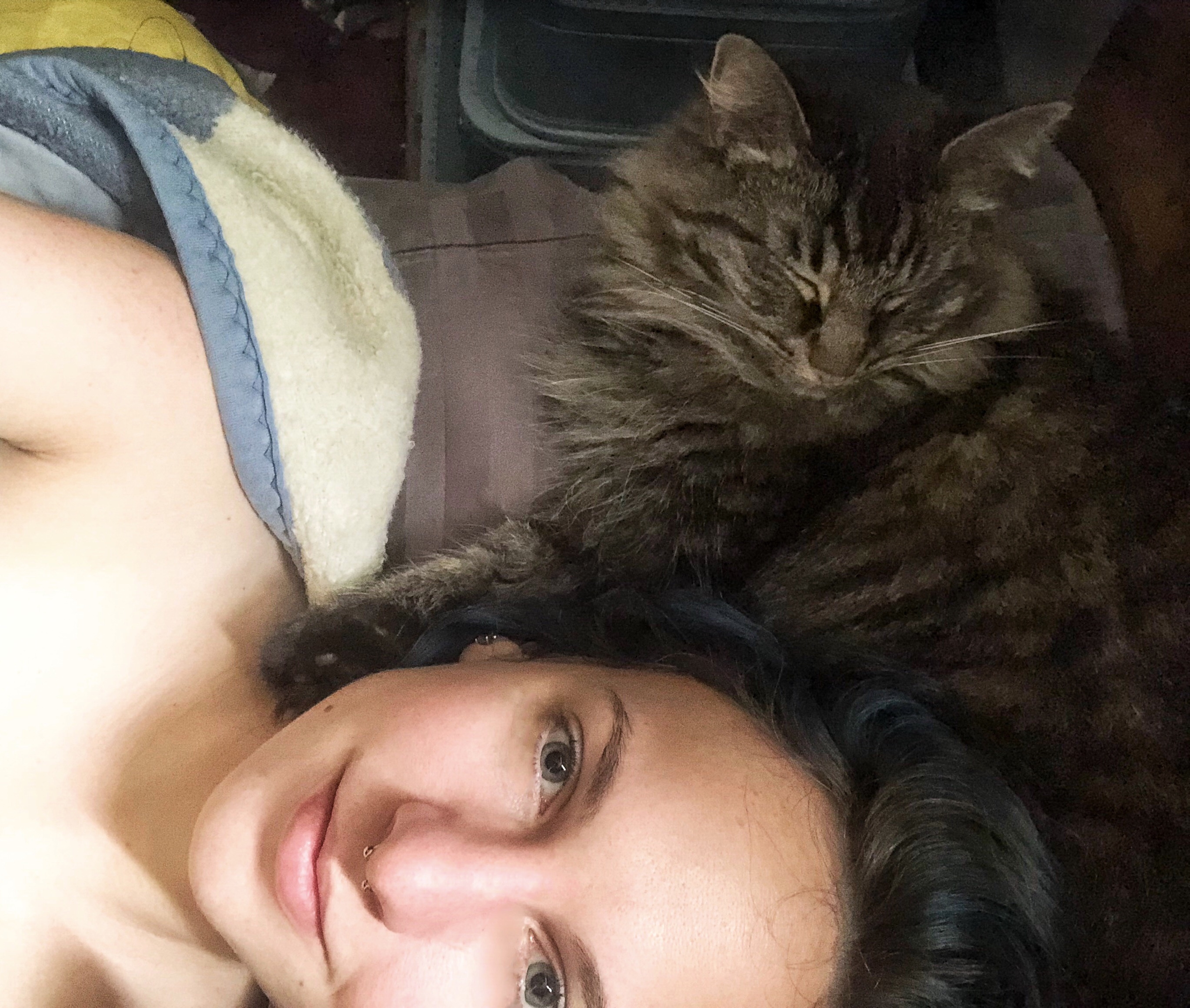
So, to celebrate my emotional gestational period, here’s a selfie of me without makeup, in a Christmas sweater I picked up off my bedroom floor and had to smell before I put it back on.
Cheers to rebirth, finding my way back to self love, and the UofM hospital psychiatric team
Disclaimer: I was raised in a white Christian household in a Judeo-Christian community in America. I don’t assume that I speak for anyone who celebrates any other sort of holiday in any other sort of cultural community.
As I sat on my couch on the Wednesday night before Thanksgiving, trying to write a post about my feelings towards Thanksgiving this year, I was literally paralyzed with anxiety. No words would come out. My interior monologue reached a level of chaos that resulted in my brain short-circuiting. I had to put my computer away, pour myself a glass of wine, do some yoga, watch an episode of Modern Loveon Amazon Prime. That’s how anxious Thanksgiving made me.
Disclaimer #2: My anxiety had nothing to do with Thanksgiving itself, although I know that is a reality for many. If you would like to know more about how I’ve tried to decolonize my brain and my thoughts on Thanksgiving, don’t talk to me, read and learn from the actual source. You can access indigenous voices on the topic here and here. Challenging my white family members on our views of Thanksgiving does make me anxious every year, but I see it as my duty and I don’t allow myself the right to complain about it.
Happy Thanksgiving from my family!
Then I realized I was anxious for many reasons that are indicative of our cultural stigmas around mental health, our societal culture of “toxic positivity,” and norms around what is and isn’t acceptable as “small talk” with people you don’t see very often. Luckily, my Thanksgiving was actually pretty amazing. There were fewer people there than usual. The relatives that did come are people I see fairly often (who are already updated on my life). None of my worst-case-scenarios came true and I was able to take breaks when I was feeling overwhelmed.
That being said, I decided I should still write a post about my feelings leading up to “the holiday season” this year, as I have a feeling I’m not alone in this anxiety. So, below you will find some of the things associated with the holidays that make them so damn hard when you have depression.
“How are you?”
I hate this question. As a culture, Midwestern Americans especially ask this question as if it’s another greeting. A mere synonym for saying hello. The problem is, I have met very few distant acquaintances/extended family members who actually are interested in how you are doing. Instead, the expected response is a simple “good” or “fine” or, if you’re feeling spicy, “living the dream.” Then we get to move on with a surface-level conversation, re-breaking the ice that formed between us over the passed months of little to no contact.
The problem is, I’m not good. I don’t feel fine. And I am definitely not living out my dreams right now. I am depressed. I just spent 48 hours in a psychiatric hospital because I made, and almost acted on, a suicide plan. I am taking a two month leave from work. But when people ask how I am, they are generally not looking for me to unload on them about my depression. They don’t want to hear the details of my low self-esteem and PTSD. When people ask “How are you?” they are looking for the culturally accepted stock-answer that will help them break the ice and feel more comfortable.
This cultural norm makes me feel trapped. I no longer have the emotional capacity to pretend everything is fine to make others feel more comfortable. Forcing myself to paste a smile on my face and make small talk like this is forcing myself back into the bottom of the well of my depression. It makes me feel disconnected, alone, invisible. Since my mental breakdown, I have decided I don’t want to pretend anymore. I don’t want to lie and say I’m fine when I’m not. And if my answer makes the questioner uncomfortable, maybe don’t ask how I am if you don’t want to hear a genuine answer.
And, ultimately, why? Why would my genuine answer make someone uncomfortable? Why would a family member, who claims to care about me, who is asking how I am, feel uncomfortable with me talking to them about my depression? Knowing my depression makes others uncomfortable is part of what kept me from opening up about it in the first place. This need to hide my depression and appear is if everything is fine for the sake of others’ comfort is part of what forced me on the island that led to my suicidal ideation in the first place.
Catching Up
Last year, at my family’s Christmas Eve party, I announced that I was the 2019 recipient of a prestigious award in public teacher terms, especially as a 4th year teacher. This year, at my family’s Christmas Eve party, I have nothing to announce. My only “news” going on in my life right now is my mental breakdown.
I only see many of my family members twice a year: for Christmas and for our family reunion in the summer time. We are not unique in this pattern. “The Holidays” are a popular time of year for making announcements as most people can count on getting their family in one place for in-person communication and celebration. Even sans important announcements, these infrequent meetings usually result in a great deal of catching up. I can expect a lot of questions about my life, my job, and the general goings-on over the previous six months of not seeing each other.
Let me be clear, the practice of asking about your family members’ lives is not a bad thing. The problematic part is our cultural stigmas about what types of “news” people often feel comfortable sharing and/or hearing about. Telling my family about an award I won was exciting and exhilarating. I announced it with pride, confidence, and (dare I say) swagger. On the other hand, having a mental breakdown, spending time in a psychiatric hospital, and taking a leave from work; all that doesn’t seem like news I should be sharing. It’s too negative, too dark.
When I think about answering my relatives’ queries with the truth about what is going on with me, I feel embarrassed and ashamed. Like I somehow failed (especially in comparison with where I was in my career last year). Furthermore, the topic of mental health isn’t something many families I know talk about openly. I’ve operated within a dynamic my entire life where we only talk about happy things because we don’t want to bum anyone out or make anyone uncomfortable.
This seems harmless. If I don’t see someone for a while we obviously want to keep our time together positive and fun. Unfortunately, this is an example of “toxic positivity.” According to Psychology Today, “The phrase “toxic positivity” refers to the concept that keeping positive, and keeping positive only, is the right way to live your life. It means only focusing on positive things and rejecting anything that may trigger negative emotions.” Forcing ourselves to only share positive things reinforces feelings of shame and failure when you are going through something that isn’t positive. Feeling ashamed of my depression is part of what made it so difficult for me to seek help. Feeling like my loved ones don’t want to hear about my darkness reinforced my need to pretend everything was fine. This led to those same feelings of isolation and invisibility. My depression is part of me. I don’t want to be ashamed of it anymore.
Hugging
If your family is like mine, everyone expects a hug hello, and a hug goodbye (I also have 27 first cousins, and my family events run 100 people strong so this process takes some time). I love my family very much. I am not a hugger.
Being forced to hug family members as a kid was the earliest messaging I received that my body is not my own property. I have anxiety. Part of my anxiety is an extreme discomfort being touched by people with whom I don’t have an intimate relationship. Regardless of my feelings towards hugging, I grew up in a socio-cultural environment where it was considered rude if I didn’t hug even one family member in both greeting and farewell. If I refused to hug someone, my elders would be disappointed in my “attitude.”
The knowledge that I will be forced to hug 100+ people that I barely ever see is daunting. Attending a family party means knowingly walking into a situation where I will be forced out of my physical comfort zone against my will over and over again. Additionally, the knowledge that my natural boundaries around physical touch is a disappointment to my family members increases my feelings of shame and failure about my mental health.
I do love “the holidays.” Like many people I know, some of my favorite childhood and family memories center around this time of year. But I also have depression and anxiety, and navigating the holidays and mental health is difficult. If you’re reading this and you have a family member that suffers with mental health issues, think about what it would take to be an ally to them as they navigate the social politics of family functions this time of year. Although spending time with family can be stressful, it was also my family that made my Thanksgiving so pleasant as the people in attendance chose understanding and support over commitment to social norms. And that’s all I can really ask for.
Chosen Family: People who you care about and consider family.
This term has emerged within the LGBTQ+ community to describe the support systems queer folks build themselves (often after being rejected by their natural families).
It is a term I want everyone to know. There is power in this term.
As a culture, Americans often put a lot of stock in the “nuclear family.” One mom, one dad, and their biological children. This cultural value has crept its way into every american’s brain through politicized homophobia in our government.
When we move away from thinking about the “nuclear” family and towards the “chosen” family, we empower ourselves to find love and support within a wider, more complex and interesting community.
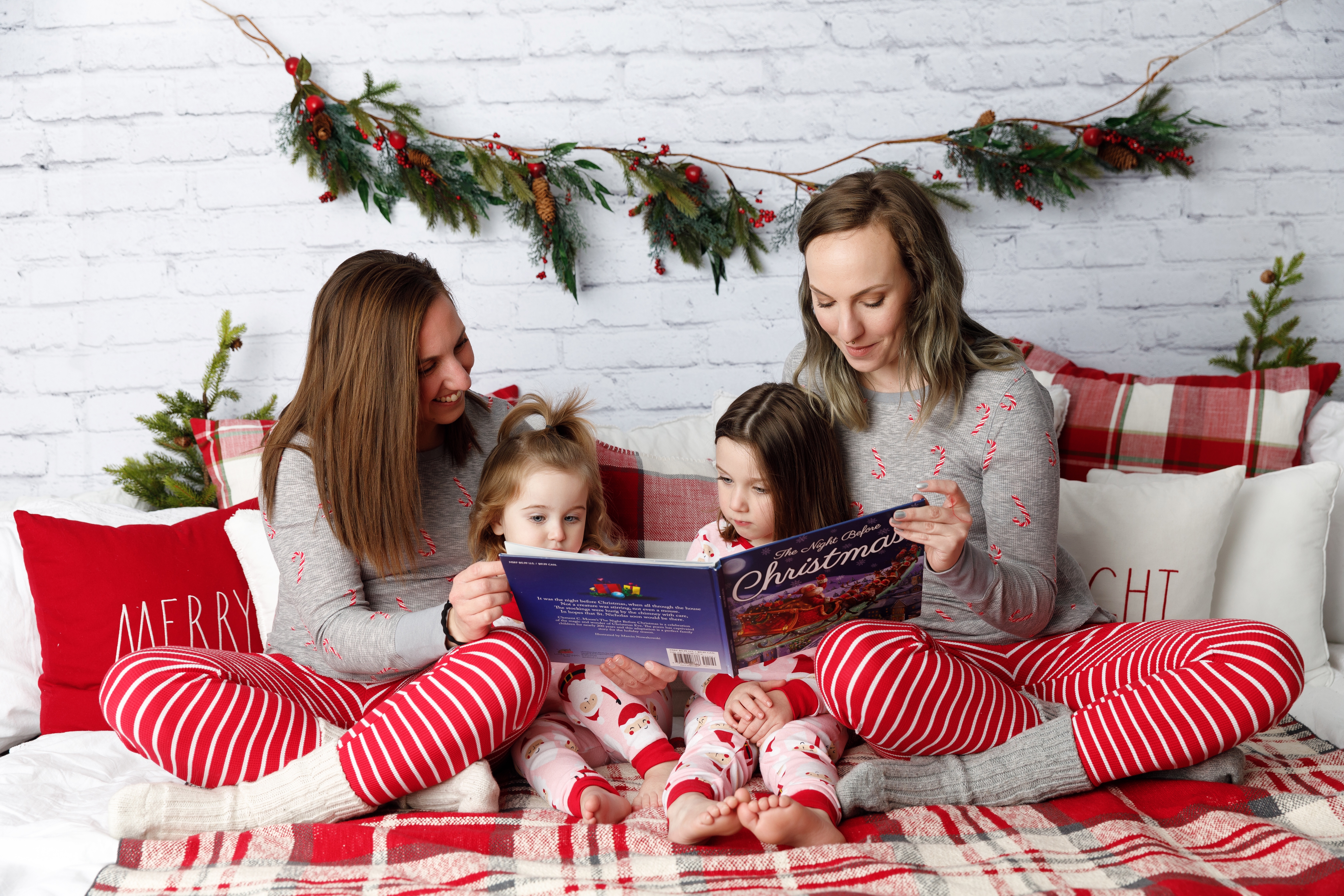
These are pictures of my sister, my nieces, and me. A different kind of chosen family than you were probably thinking after reading about the term’s connection with the LGBTQ+ community. I am not attempting to co-opt the term from the LGBTQ+ community. Nor would I like to detract from the conversation about family and acceptance for LGBTQ+ folks. And, for all intents and purposes, assuming there has to be romantic love between parental figures is indicative of our cultural heteronormative indoctrination.
These are my nieces. But in a lot of ways I have been a parental figure to them since they were born. I have changed their diapers, helped sleep train them when my sister was at her wits end, comforted them through cutting their first teeth, taught them new words, done my best to instill values of open-mindedness, kindness, and inclusiveness within them, and sometimes I’m the only one that can get them to eat.
My sister and I also have had a yin and yang connection since I was born (her fiery aries personality clicks perfectly with my wishy-washy pisces). We have been each other’s unconditional support system for eternity.
These family portraits mean so much to me because they represent one of the most important familial connections in my life. This is why I survived and continue to survive 💕
I am a pisces sun, gemini moon, and pisces rising. I barely know what that means. To be honest, I don’t even know if I used the correct verb in that sentence (is it “I am a…” or “I have a..?”). I don’t really “believe” in astrology, literally speaking. But I love astrology. And I believe there is utility in astrology. I follow meme accounts on Instagram. I have a pisces symbol tattooed on my left wrist. I’ve been known to drop the occasional, “You’re such a [insert sun sign here].”
But I am also an atheist. I have never been spiritual, or religious. My parents tried their best to make me a Christian, but I was never a believer. I am pretty cynical about belief-systems in general. So why? Why would a self-identified [depressed] atheist be interested in astrology?
Astrology provides me with a language to talk about myself in a positive light.
I have been working really hard recently to improve my self-image. I’ve always had low self esteem. One of my goals is to develop more self-compassion and self-love. In all the emotional work I’ve been doing, I always get tripped up on a lack of language to speak about myself positively. After a lifetime of self-criticism and self-doubt, I haven’t spent much time trying to define the things about myself I like.
Horoscopes and internet literature about astrology and sign-based characteristics use affirming language. They cast a diverse range of personality traits as strengths. The weaknesses, or personality flaws, paired with each sign are typically described through a narrative of self-acceptance. By seeing yourself in these descriptions you feel good about yourself and a connection to other people with a common identity.
Astrology allows me to communicate about my feelings without having to be too vulnerable.
When I see things on the internet that express feelings that I identify with, it’s exciting. This isn’t a unique phenomenon. The flourishing of our meme and gif culture is evidence of our desire to see our inner-most feelings represented through a clever reference or image evoking a common feeling among those who see it.
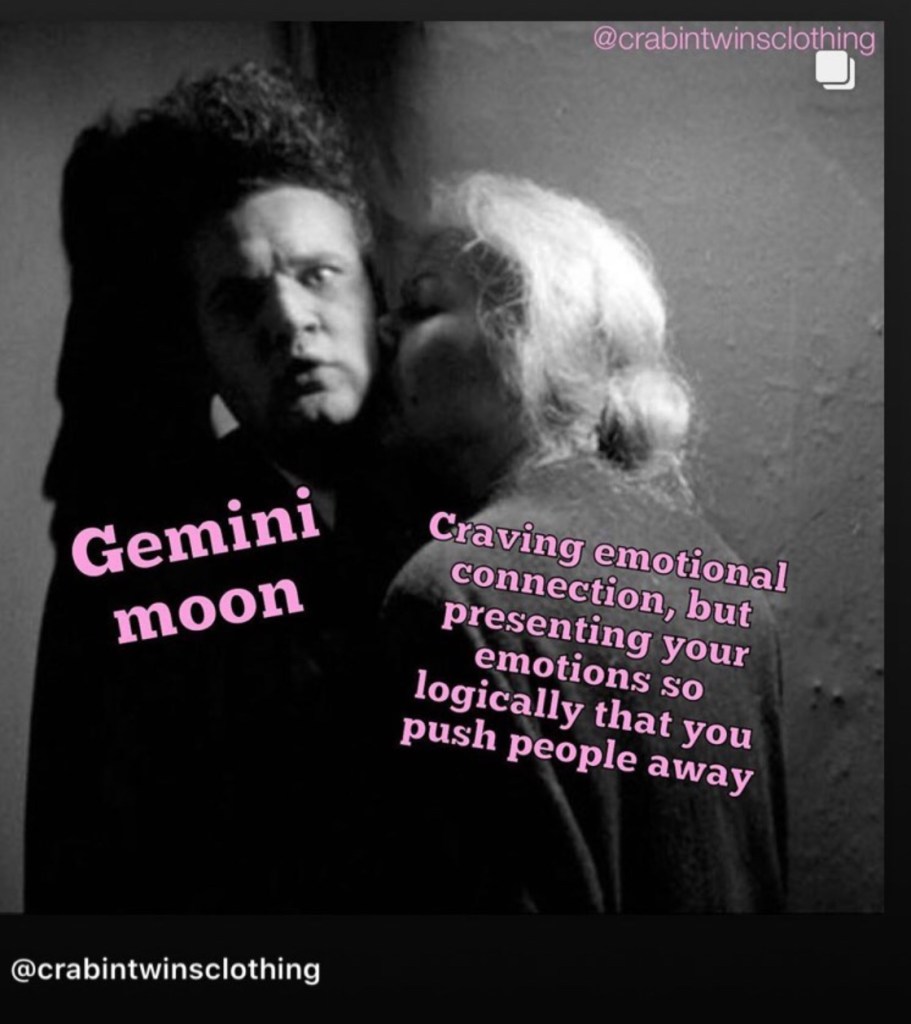
I’ve never been very skilled at sharing my emotions with anyone. So, when I see a meme that explains one of my feelings by pointing to my gemini moon, it feels validating.
Then, being able to share that meme allows me to share that intimate part of myself in a risk-free way. And anyone who takes the time out of their day to look at my post has the potential to feel a little bit more connected with me (I thought about this because of a meme shared on Instagram from my favorite astrology meme account @crabintwinsclothing). I don’t know if that emotional quality I have really is due to my moon sign. But either way, does it really matter?
Astrology is a conversation starter. And I suck at small talk.
I really have a difficult time meeting new people. I am super awkward at introductions. I don’t do well with small talk. Unfortunately, we live in a world where small talk isn’t altogether avoidable (and I don’t want people to think I’m a dick).
Luckily, the pisces tattoo – easily visible on my wrist – often becomes a great ice breaker (frankly, all of my tattoos are conversation starters, whether I want the conversation or not. But that’s a separate issue). When people see the little black symbol, they automatically have a connection to it. I’m not fluent in astrology, but for the most part its present enough in our culture for me and any random stranger to have some kind of conversation about it. Or, when I’m desperately casting around for a topic of conversation to fill the billowing silence I see the tattoo out of the corner of my eye and latch on. I’m fine being the quirky girl asking you about your sign. In this way astrology serves the same purpose as any other label we choose to apply to ourselves. Queer, feminist, atheist. It helps us drive connections with others who have the same interests, ideas, and identities as us.
I am an atheist. There is no god or afterlife I believe in. But I am also depressed. And as a depressed-person, I reserve the right to use whatever tool I want to drive connections between myself, my community, and the world. Maybe astrology isn’t “real.” Maybe it is “basic” or “trendy.” But if it helps me feel alive, then who fucking cares?
I have struggled with insomnia as long as I’ve struggled with depression. Puberty hit and my brain became my worst enemy. High school and undergrad for me were a stream of foggy mornings after spending nights staring at my alarm clock, doing the mental math to figure out how much sleep I could get if my brain would just shut off. I operated for decades on 2-4 hours of sleep if I was lucky. I had a small collection of friends who were fellow insomniacs. We would stay up all night texting, attempting to chase away the darkness consuming our overtired brains. There were many nights I didn’t sleep at all.
Since starting medication to manage my depression in December 2018, it seemed I finally had my insomnia under control. Balancing out my mood resulted in 8-10 hours of sleep nightly. I fell in love with sleep. I learned what it felt like to conduct my days well-rested. I became a nap enthusiast. I even slept in on the weekends. I forgot what it felt like to wander the house like a ghost, listening to the sounds of the blissful sleep gracing everyone else with its presence.
Since this newest, and rather more intense, depressive episode, my relationship with sleep continues to shift. Since the beginning of October I had been over-sleeping. I came home from work and immediately would fall asleep on the couch, only to wake one more time to eat dinner. I would put my head down on my desk and sleep during my prep hours at work. On weekends I wouldn’t even get out of bed. Although I realize this isn’t the healthiest relationship with sleep, I would take it any day over insomnia. I was enjoying my oversleeping. Relishing in my blanket nests I built in various places around my house. Finding comfort in the blissful oblivion of my subconscious mind. That is, until last Friday.
Last Friday, insomnia came rushing back to me like your least favorite ex that you keep bumping into when you’re at Target and it’s been 3 days since you’ve washed your hair. And I’m realizing for the first time the connection between my insomnia and my depression.
My insomnia and my depression feed each other. They’re best friends. Business partners. Lovers. As I lay here frustrated at a time of night I would so much rather not see, my brain careens down a darkening path that makes me feel sad, chaotic, and out of my own control.
Thoughts I’ve been trying to avoid stream across my mind and multiply. I feel alone. I feel sad. I feel hopeless. I feel disconnected. I feel empty. I hate my brain. I hate myself. I feel annoyed that I’m here, awake, having these thoughts when I could be sleeping. When I should be sleeping. I just want to fucking sleep.
Me and my cat, Detective Olivia Benson, after a particularly good nap. Look how happy we are.
I am one person who has made a suicide plan I didn’t act on. I wouldn’t begin to assume that I am able to speak for anyone else who has experienced depression, suicidal ideation, and/or suicidal attempts. That being said, I decided to turn this letter into a blog post in the hopes that someone, somewhere is helped or feels a connection to it.
Since leaving the hospital, I have found that my support system has had a difficult time supporting me in the ways I need. In my opinion, societal stigmas surrounding mental health has created a culture of silence. This culture is so instilled within us, it often makes it terrifying for a would-be supporter to approach their loved-one going through depression. So, in the spirit of being more open about my emotional needs, I wrote a letter to my loved ones about how I would like them to support me:
Dear Loved Ones,
I understand that it must be difficult to approach me right now. What I’m going through must seem confusing and scary. I know you are trying to be there for me, but you may be struggling to know what to do. Therefore, I created the following list of things you should know as you think about supporting me:
This has nothing to do with you.
I love you very much. There’s nothing more you could have done to have prevented me from being suicidal. Those were not thoughts I shared out loud with people. And when I did share them out loud, the people I shared with responded appropriately. We followed protocol. I went to the hospital. I am alive. If I had confided in you about my suicidal thoughts, I believe you would have gotten me the help I needed.
Reaching out to remind me I can confide in you is much appreciated, don’t expect me to respond.
I want to hear from you. I want a heartfelt reminder that I can talk to you. That my mental health issues aren’t going to scare you away. That you love me and would be devastated if anything happened to me. This is helpful as I experiment with talking about my emotions and allowing myself to be needy. I want to know if you’re open to talking about mental health.
That being said, I don’t owe you anything. Please do not be offended if I don’t confide in you. Please don’t feel as though I’m snubbing you if you find something out on my blog and I didn’t tell you in person ahead of time. I got to this point because I have devastating issues talking about my struggles. I am sharing exactly what I can, with whom I can, when I can. I want more people to know more about me and my journey. But I can only share information in my own way, at my own pace.
I am desperately needy for your time and attention.
Acts of Service and Quality Time were tied for my top Love Languages. I am feeling very raw, emotional, and needy right now. I feel a deep sense of loneliness. Worse still, it’s a loneliness I created myself. I am so fixated on being the perfect friend, and not being a burden, that I don’t confide in people. Therefore, people don’t ever know when they need to be there for me. Well, right now, I need you to be there for me.
I understand what it’s like to be busy. As a teacher, I realize that “time” is everyone’s least favorite four-letter-word. I have struggled giving my loved ones my time in my adult life. I want to change this. It is one of my personal goals to give my quality time more freely to those I love. You may not have the most time to spend on me, but if you would be willing to pencil me in, reach out, set something up, even if it’s just lunch.
When we spend time together, we don’t necessarily have to talk about suicide, depression, or mental health. I would actually probably rather not.
Not everyone is comfortable talking about mental health. Not everyone is ready to hear the nitty-gritty of all my baggage. I may not even be ready to tell you that stuff. So when I say I need your attention, I literally mean I want to hang out. I want to have good conversation with eye contact and minimal distractions. I want to watch and discuss true crime documentaries while eating ice cream out of the container. I want to get weirdly invested in trashy competition shows that mean very little to our lives. I want to come up with ridiculous business plans that we will never follow through on.
I won’t be able to commit to certain activities for a while.
Sometimes when I’m depressed, I can’t stand being in public. It makes me feel like there is a spotlight on me. Like someone flipped over a rock and exposed me at my slimiest. Sometimes, in the middle of a depressive episode I will get a burst of energy. And I want to spend time outside. I want to feel like I’m part of the world again.
The thing is, I can’t guarantee what I’ll be in the mood for at any given time. Therefore, please be patient with me if I need to change plans at the last minute, or if I attend the beginning of an event and then have to leave earlier than planned. Please don’t take it personally if I bail. Or if I come, but am not the most animated and energetic version of myself. I appreciate you and your invitations to anything you want me to attend. Please keep them coming. Please realize that me declining your invitation doesn’t mean I don’t love you. It just means I’m not feeling able to fulfill the social expectations of that event at the moment.
I know that all of this is difficult. A big part of the difficulty is that we’re both grieving the fact that I nearly took my own life. I’m sad about it. I’m sure you’re sad about it. We can be sad together, and then we can move on together too.
My depression has always been a part of me. But I have never really known it.
It has been more like a tumor, a parasitic growth. The quintessential monkey on my back that I ignore, but that controls me anyway.
You see, I thought ignoring it was the way I could loosen its grip on my soul.
I thought ignoring it was how I could live a “normal” life.
I thought ignoring it was taking back the power.
I was wrong.
I am here because I wanted to commit suicide.
I don’t want to die. I do want to take back the power. And I’m starting to realize that the only way to do that is to look my depression dead in the face and accept it as my own.
What no one seems to mention about self love, is the fact that it means loving every part of yourself. My depression is part of me. It isn’t fun, but continuing to hate it means I will continue to hate myself. Trying to kill my depression means I will always be trying to kill myself.
When I thought about some of the people I admire who have killed themselves (Anthony Bourdain, Sylvia Plath), it made me feel like depression is a battle I would eventually lose. I thought of it as a terminal disease that would eventually “get me” in the end. It would just be a matter of when.
It is this mentality of constantly running from my depression that made it so difficult to live with.
Then, once I was sexually assaulted, I started running from my trauma too.
I’ve been running. And running. For so many years. My depression and my trauma? They finally caught me.
So, here I am. At the psychiatric care unit of the University of Michigan Hospital.
I’ve finally stopped running. So it seems like it’s time to turn around and face what I’ve been running from. I want to get to know my depression. And my trauma. What do they want? What should I do to acknowledge them appropriately and put them to bed, until the next time?
I want to talk with and about my depression and my trauma. Without fear of judgement. Without worrying about stigmatization.
I want to take up space with my depression and trauma. As if they are worthy of peoples’ time, energy, notice.
For people to know me, they need to know my depression.
For people to love me, they need to love my depression.
For me to love myself, I need to love my depression.
So, what does my depression give me that I wouldn’t otherwise have?
Empathy
Patience for others going through mental health crises
Appreciation and gratitude for moments of pure happiness
Poetic understanding of the complexity of human emotion
Complexity of worldview that others find interesting
The ability to make others suffering from depression not feel alone
The drive to educate myself and fight to improve mental health support in my community








 An Experiment with Vulnerability